
Running a Sex Offender Check in Mobile County
The Alabama Sex Offender Registry is the first public channel for a Mobile County sex offender check. ALEA's Criminal Justice Information Services Sex Offender Registry Unit runs the repository, while local police and sheriff personnel collect and verify registration data. ALEA says the registry updates daily in real time from local submissions. That makes the state system the best starting point for a current public profile. It is not a list of every sex-related arrest or adjudication. Alabama publishes only qualifying matters under the Community Notification Act, and the law limits public treatment for some first offenses, juvenile cases, youthful-offender cases, and certain cases from other jurisdictions.
Use the official entry for a name, address area, city, county, ZIP, or noncompliant-status search. The automated vendor interface blocked inspection during research, so its current button names, menus, radius choices, alert fields, and page controls cannot be confirmed here. If that interface does not load, open ALEA's registry gateway and follow its official link. For a possible wrong Mobile County address or proximity violation, contact local law enforcement rather than trying to confront anyone. Cross-state research belongs in the federal national portal.
Mobile County Registry Updates Reach ALEA
Mobile County registration records begin with local verification. Mobile County law enforcement registers a person covered by Alabama law and sends the current forms, fingerprints, photographs, addresses, vehicles, and qualifying offense information to ALEA. ALEA then maintains the public repository. Publication follows a qualifying conviction and release through probation or the end of a sentence, but only offenses named in Alabama Code section 15-20A-5 qualify. A missing Mobile County result can reflect a statutory publication rule, not a finding that no case or duty ever existed.
The ALEA registry guidance explains the state and local roles in that chain.
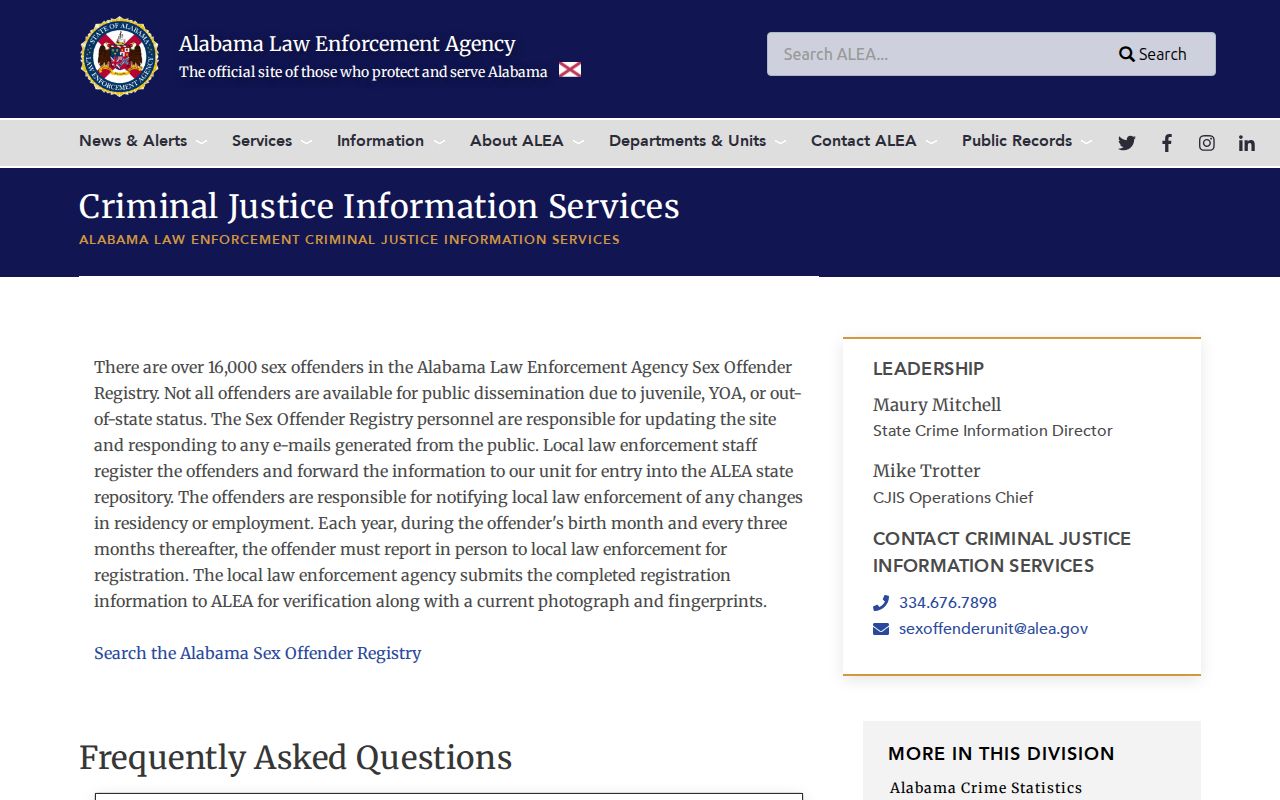
The ALEA source helps a reader separate the statewide public record from the registration work done in Mobile County.
Searching the Alabama Sex Offender Registry
Start a Mobile County search with the official registry and use the narrowest known fact. A full name may identify a person, while a place-based mode can support neighborhood awareness. Compare the profile's photograph, physical description, aliases, address, and offense history before drawing a conclusion. Do not assume that the first same-name result is the right person. The public system also supports noncompliant-status functions, which can help direct a Mobile County concern to law enforcement.
- Open the official Alabama Sex Offender Registry through ALEA's gateway or the state-linked search address.
- Choose a confirmed search mode, such as name, address or geographic area, city, county, ZIP, or noncompliant status.
- Review the results and compare several public identifiers instead of relying on a shared name alone.
- Open the profile, read the qualifying offense and compliance fields, then report a suspected error to local law enforcement.
The live vendor form was blocked during research. The table therefore records only functions confirmed by official materials and does not claim exact labels, field types, or required settings.
| Confirmed Function | Public Use | Required | Interface Note |
|---|---|---|---|
| Name | Find a possible profile by identity | Not confirmed | Exact live label and matching rules were not visible |
| Address or geographic area | Review records tied to a place | Not confirmed | Current radius and map controls were not confirmed |
| City | Narrow a place search to Mobile | Not confirmed | Officially confirmed search function |
| County | Narrow results to Mobile County | Not confirmed | Officially confirmed search function |
| ZIP | Search a postal area | Not confirmed | Exact format rules were not visible |
| Noncompliant status | Review a reported compliance category | Not confirmed | Status function is confirmed, controls are not |
Mobile County Registry Profiles Have Limits
Alabama Code section 15-20A-8 controls what may appear in a Mobile County public registry profile. It permits a broad set of identity, location, vehicle, offense, and status facts, yet it also keeps sensitive material off the public page. Non-conviction arrest history, Social Security numbers, travel-document identifiers, victim identity, email or instant-message identifiers, and internet-service-provider details are not public registry fields. A Mobile County profile is therefore a statutory public record, not a full police file, complete court docket, or statewide rap sheet.
The Alabama public-information statute sets that line.
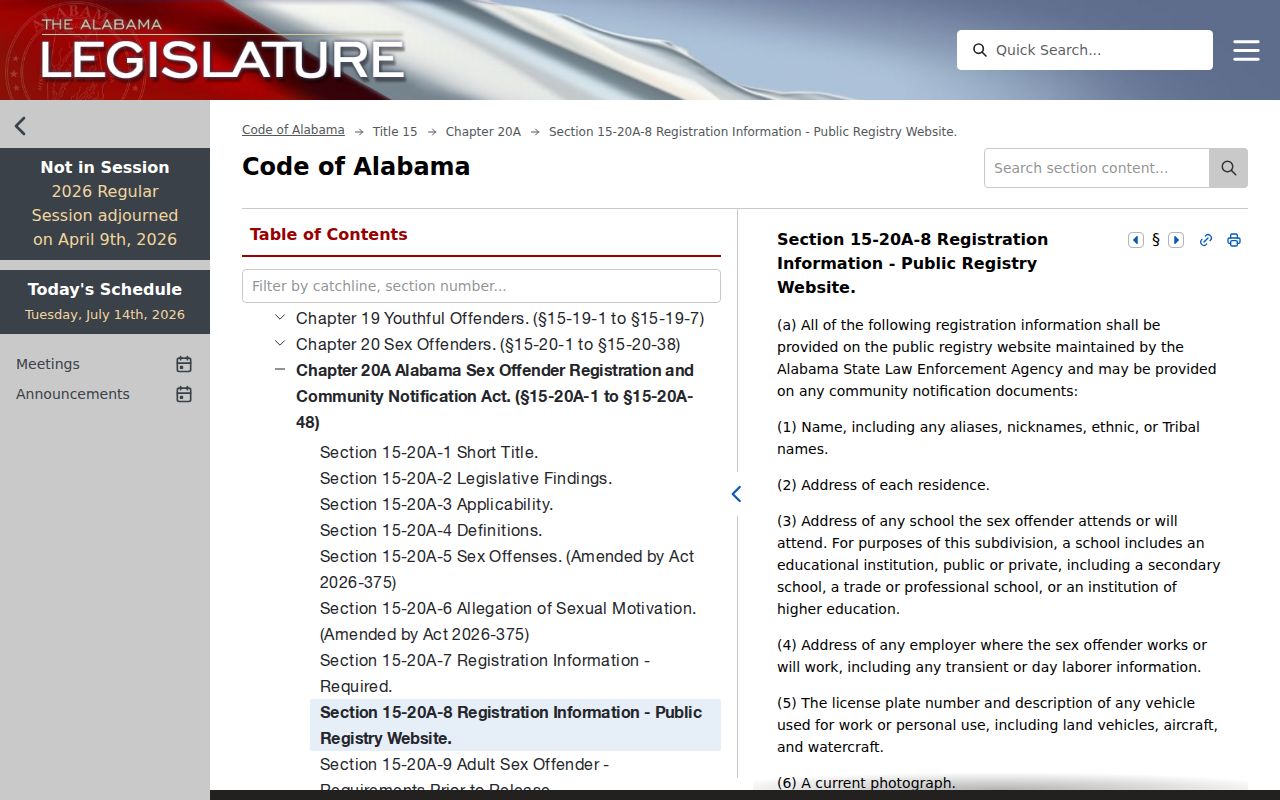
The statute is the source to check when a public profile seems to omit a field that another type of criminal record may contain.
First convictions for Indecent Exposure or Sexual Misconduct are not posted. Juvenile and youthful-offender publication is limited. Some out-of-state, federal, military, or Indian-country cases require due process before publication. These rules explain why a public registry search and a court-record search can yield different kinds of information.
What a Registry Profile Shows
A Mobile County registry profile can support a careful identity check and show why the person is listed. Public identity fields can include aliases and nicknames, which matter when a legal name has changed or a common name produces several Mobile County results. Location fields can reach a residence, school, and employer address. Vehicle descriptions may cover a work or personal vehicle, aircraft, or watercraft, along with plate details. The offense area states the qualifying sex-offense history and can link the reader to the law behind it.
| Name & Aliases | Name, aliases, nicknames, and ethnic or Tribal names authorized for public release |
|---|---|
| Photo & Description | Current photograph and physical description used to help confirm identity |
| Registered Locations | Residence, school, and employer addresses published under Alabama law |
| Vehicles | Descriptions and plates for covered vehicles, aircraft, and watercraft |
| Offense Record | Qualifying sex-offense criminal history and applicable statute text |
| Registration Status | Public compliance or absconded status reported through the registry chain |
| Fields Kept Private | Non-conviction arrests, SSN, travel IDs, victim identity, online identifiers, and ISP details |
Read the status and offense facts together. A photograph or address alone does not explain the legal basis for publication, and an older image can make a name-only match less reliable.
Mobile County and National Registry Searches
A person who has lived or worked in more than one state may require a broader search. The U.S. Department of Justice runs the National Sex Offender Public Website, or NSOPW, as a search layer across participating state, territorial, and Tribal public registries. It is useful when the place tied to a record is uncertain. Alabama's own registry remains the more direct source for the state profile and Alabama-specific compliance information.
The official National Sex Offender Public Website supplies that cross-jurisdiction search.
The national layer broadens a Mobile County registry check without replacing the local reporting office or ALEA's Alabama record.
Search both sources when a Mobile County record may cross state lines, then return to the originating jurisdiction for the most specific public profile. A no-result response from one portal should not be stretched beyond that portal's scope.
Registration Requirements and Levels in Alabama
Alabama does not mainly label public adult records as Tier I, Tier II, and Tier III. Adult duty is generally lifetime, with an in-person check during the birth month and every three months after that. Each quarterly appearance and residence event carries a $10 registration fee due within 90 days. A homeless registrant must report every seven days. Juvenile duration and public treatment can differ because courts assess low, moderate, or high risk.
| Alabama Category | Duration and Verification | Public Treatment |
|---|---|---|
| Adult qualifying offender | Generally life; birth month and every three months afterward | Public unless a statutory exclusion or status applies |
| Juvenile lifetime category | Life; quarterly; possible relief petition after 25 years | Court-determined; high risk treated like an adult |
| Other qualifying juvenile | Ten years from first release; annual verification | Court-determined |
| Youthful offender | Juvenile treatment for a qualifying first offense under 18; otherwise adult | Depends on statutory treatment |
The category table is more accurate for Alabama than a generic three-tier chart. It also shows why a Mobile County juvenile record may have a different term or notice level than an adult Mobile County registry profile.
Mobile County Registry Distance Rules
Community notice and residency limits use different distances. In Mobile, the police chief notifies legal residences within 1,000 feet and schools or childcare facilities within three miles. Adult residence is generally barred within 2,000 feet of a school, childcare facility, former victim, or the victim's immediate family. Certain cases involving a victim under age 12 add a 500-foot anti-loitering rule around places centered on children. A map point by itself does not resolve how a boundary is measured or whether a statutory exception applies.
The Mobile community-notification statute provides the notice framework.
The source clarifies that a community notice radius is not the same rule as a residence restriction or anti-loitering limit.
Report a suspected wrong address or proximity issue to the police department or sheriff with jurisdiction. Officers can check the record, location, and legal status. Public users should not attempt their own compliance action.
Mobile County Registry Compliance Work
The Mobile County Sheriff's Office listed 978 registrants in its 2023 report. It also reported more than 180 potential noncompliance investigations that produced more than 200 warrants. Those figures show why the public profile and the local verification record can change. They also explain why suspected bad information belongs with the registration office rather than on neighborhood social media.
The MCSO registry compliance report documents that local work.
The county figures connect ALEA's statewide registry to verification, investigations, and warrants handled close to Mobile County.
Registration contact is at 510 South Royal Street, Mobile, Alabama, with the published number 251-574-2423. Exact counter hours and a separate direct line were not published in the research. Call first before making an in-person trip. Give the office enough detail to identify the profile and the suspected issue, but do not circulate private or speculative claims.
Lawful Use and Community Notification
Mobile County registry information supports personal safety, family planning, and community awareness. It does not authorize punishment by members of the public. Use a Mobile County sex offender check to understand a public record, confirm a profile through official sources, and share a suspected compliance problem with law enforcement. Identity mistakes can harm people, so compare more than a name before relying on a result.
Registry misuse is a crime: Alabama Code §15-20A-21 bars using registry information to injure, harass, or commit a criminal act against a registrant or another person.
For a suspected false address, noncompliant status, or restricted-location issue, save the public profile details and contact the agency with jurisdiction. An official report gives trained staff a chance to verify the facts and update the record chain.