
How to Check Criminal History in Mobile
A Mobile criminal history check works best as a short sequence, not one broad name search. Begin with the Mobile police report if the event involved Mobile officers. Check Mobile Municipal Court when the matter is a city ordinance, traffic, nuisance, or city misdemeanor case. A Mobile arrest can then create a separate Metro Jail booking entry, and a charge outside Mobile Municipal Court's scope can create a District or Circuit Court file. ALEA's fingerprint-based personal review is the statewide route for someone reviewing their own Alabama criminal history, but it does not replace the source Mobile police report or court docket.
- Identify whether Mobile Police, Municipal Court, Metro Jail, or a county court created the record you need.
- Ask MPD Records for a city report or local check, using the case number or exact event location when required.
- Search Mobile Municipal Court by a confirmed name or number route for city-level cases and warrants.
- For custody or a county prosecution, move to Mobile County booking and court channels and verify the filed charge there.
- Use ALEA's fingerprint-supported personal review only when the subject needs a broader Alabama identity record.
Do not treat a blank Mobile result as proof that no record exists. The event may sit with MPD but not Mobile Municipal Court, may have moved to county court, or may be outside Mobile altogether.
Inside Mobile Police Records
Mobile Police Department Records is at 2460 Government Boulevard, Mobile, Alabama 36606. The office number is 251-208-1991, and published hours are weekdays from 8:00 a.m. to 5:00 p.m. MPD says the unit handles about 6,000 reports each month. That volume makes precise identifiers useful. Accident and eligible incident-report requests require a case number or the exact location where the event occurred. A $15 local check requires an in-person visit, valid state or federal photo ID, and a Social Security card.
MPD's official records and forms source outlines the products and request rules.
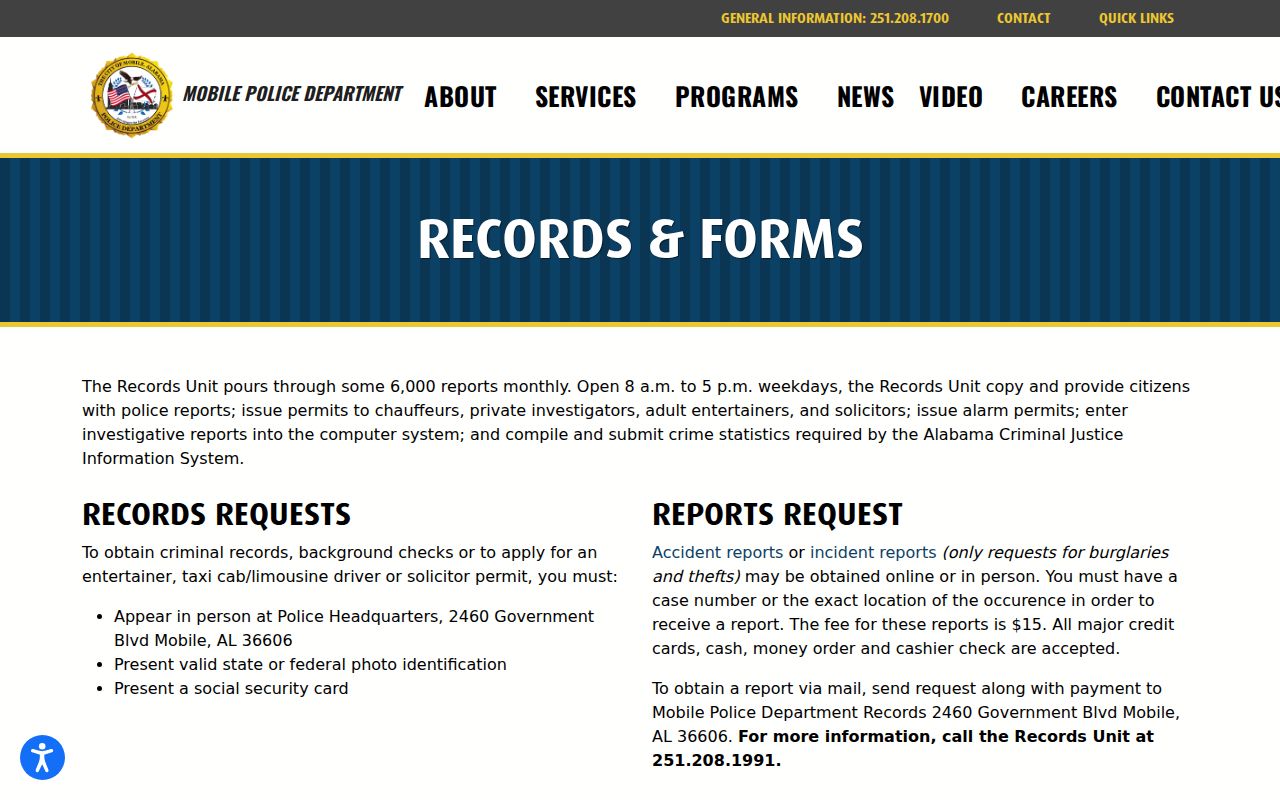
The MPD source is the Mobile starting point for police reports, a local check, eligible online reports, and fingerprint appointments.
Mobile Police Records
2460 Government Boulevard
Mobile, AL 36606
251-208-1991
Weekdays, 8:00 a.m. to 5:00 p.m.
The Mobile Police Department
MPD creates the Mobile incident or arrest report for events handled by its officers. Those reports can contain narrative facts, property details, witnesses, officer actions, and event times or places, subject to lawful redaction. The Mobile record remains with MPD even if an arrest later produces a county jail entry or county court case. Mobile requesters should therefore ask which agency wrote the report before going to a clerk or jail office.
MPD also offers fingerprint service for $15 by appointment through 251-208-1991. The person should arrive 20 minutes early and no later than 3:30 p.m.; cards are completed in black ink. Research did not confirm an MPD record-lookup app. Mobile 311 is not a police-record channel. For a local check, MPD's product is limited to Mobile police records and should not be described as an ALEA statewide rap sheet.
Mobile Incident Report Routes
MPD separates report types by access route. Accident and eligible incident reports cost $15. The requester needs the case number or exact occurrence location. Online incident requests are limited to burglary and theft. Other incident reports require the Records Unit route instead of the online form. Major cards, cash, money order, and cashier's check are listed payment methods.
If a Mobile crash report contains an error, the records counter is not the office that rewrites the officer's account. Contact the Mobile officer who made the report or that officer's sergeant. This split matters because Mobile records staff release the filed report, while the reporting chain handles a correction. For any request, name the record, event, date range, and known case number as closely as possible. A focused Mobile request is easier to locate and less likely to be delayed by an unclear description.
Note: A burglary or theft report may have an online route, but other Mobile incident records still go through MPD Records.
Arrests and Bookings in Mobile
A Mobile Police arrest and a Metro Jail booking are linked events, but they are different records. MPD keeps the police report and arrest account. Under the city and county joint-jail arrangement, the person is booked into Mobile County Metro Jail, where the sheriff's system creates custody data, booking charges, bond information, and release status. The official 24-Hour Booking and Who's in Jail channels serve recent custody questions. If an embedded service fails, the automated jail information line is 251-574-6412.
The filed charge and final result belong to the court record, not the Mobile booking entry. Mobile Municipal Court may hear a city-level matter, while District or Circuit Court can hold another part of the prosecution. Readers tracing the Mobile process can use the fuller Mobile County arrest history channels for the county booking and records-request details. A booking charge is an intake fact and allegation. It can later be amended, dismissed, no-billed, or resolved in court.
Mobile Crime Records in 2025
MPD's 2025 annual report gives context for the records moving through city channels. Part I crime fell 11 percent. The report counted 32 criminal homicides, down six or 16 percent. Sex offenses fell 32 percent, robbery 11 percent, aggravated assault 11 percent, burglary 7 percent, and larceny 13 percent. Total violent crime fell 12 percent, while vehicle theft rose 1 percent. Part I crime stood 52 percent below its 2016 level.
These figures describe Mobile trends, not the history of any person or the result of any case. They also help explain why Mobile report volume does not equal its arrest count or Municipal Court caseload. One Mobile incident may produce no arrest, more than one report, or a case outside Municipal Court. Use the Mobile annual totals as local context, then return to the report number, court docket, or booking identifier for a specific event.
Mobile Municipal Court Records
Mobile Municipal Court is at 205 Government Street, Second Floor North Tower, Mobile, Alabama 36602. Its mailing address is P.O. Box 2446, Mobile, AL 36652. The court number is 251-208-7055, and hours are Monday through Friday from 8:00 a.m. to 4:30 p.m. The court hears misdemeanors, ordinance and traffic matters, and nuisance cases arising within city limits. Documents are requested and paid for at the ground-floor Municipal Payment window. No copy or certification fee was published in the research.
| Court Name | Mobile Municipal Court |
|---|---|
| Case Types Heard | City-limit misdemeanors, ordinance violations, traffic matters, and nuisance cases |
| Case Lookup Channel | Free municipal portal by name or selected number, plus the Municipal Payment window for documents |
| What the Docket Shows | Case, docket, citation, police-case, and warrant routes tied to the selected search |
| Copies & Fees | Documents are requested and paid at the ground-floor window; no current copy or certification fee was published |
Presiding Judge Holmes Whiddon and full-time Judge Carvine Adams are named on official city pages. More serious state charges and county-level matters do not become Municipal Court files merely because the event occurred in Mobile.
Search Mobile Municipal Records
The free Mobile municipal record search gives several precise routes. A name search uses last name, optional first name, and date of birth, with an optional SoundEX setting for phonetic broadening. A known citation, docket, PD case, or warrant number can bypass the broader name route. The general search is available without a login. Using the most exact number available reduces the risk of a same-name match.
| Mobile Search Field | Type | Required or Options |
|---|---|---|
| Search By | Dropdown | Name, Citation Number, Docket Number, PD Case Number, or Warrant Number |
| Last Name / First Name | Text | Last name required for name search; first name optional |
| Date of Birth | Date text | Required for name search; MM/DD/YYYY |
| Use SoundEX | Checkbox | Optional phonetic broadening |
| Selected Number | Text | Citation, docket, PD case, or warrant number required for that route |
| License Plate / VIN / State | Conditional | Hidden until applicable; state list includes U.S. abbreviations |
| SEARCH | Button | Runs the selected route without a general login |
The portal helps with Mobile Municipal Court material. It is not a countywide Mobile court search and does not replace the Mobile police report, Metro Jail booking record, or an ALEA identity-based criminal history.
Mobile Gun Court Add-On Records
A failed-to-appear case does not always return to a Mobile court calendar through the ordinary public search alone. The city's Add-On Request form asks for the defendant, case number, charge, identity information, and signature. It also requires a $100 appearance bond paid by cash, card, or money order. A failed-to-appear Gun Court case requires $200 in cash only.
If the person fails again, the bond is forfeited, add-on eligibility ends, and an alias writ issues with no bond. An alias writ is court process directing custody after the missed Mobile appearance. This is a concrete example of why a Mobile public docket status can call for action through the clerk rather than a new police-report request. Confirm the case number and current status with Mobile Municipal Court before relying on an older entry or trying to use the Mobile add-on process.
Where Mobile Records End Up
Mobile records move according to the type of event. MPD retains the incident or arrest report. Municipal Court holds city misdemeanor, ordinance, traffic, nuisance, citation, and municipal warrant files. Metro Jail creates custody and booking data after an MPD arrest. District or Circuit Court takes the relevant county-level case. Disposition reporting can then connect the court outcome to the fingerprint-supported arrest cycle held by ALEA.
Record flow: Mobile Police Department › Mobile Municipal, District, or Circuit Court › Alabama Law Enforcement Agency
The flow is not always instant. Missing fingerprint links, unmatched identifiers, or lag in agency and court reporting can create gaps. A recent Mobile event is best checked at its city source first. A filed county charge belongs in the clerk's case file, and a person reviewing their broader state identity record uses ALEA's personal process. The broader Mobile County criminal court case records explain how filed charges, docket events, and dispositions differ from police and booking entries.
Mobile Criminal Records Since 1820
Mobile's municipal record chain has deep local roots. The city was founded in 1702 and passed through French, British, Spanish, and American rule. Municipal judicial records reach back to a mayor's court in 1820. A recorder's office appeared in 1840, and the current Municipal Court name dates to 1962. That history helps explain why a city court file is its own record source rather than a mere copy of the county docket.
Modern police coverage is divided among five precincts and 46 continuously patrolled beats. MPD provides a precinct source for locating the part of the department tied to an area.
The official Mobile Police precinct directory shows that local structure.
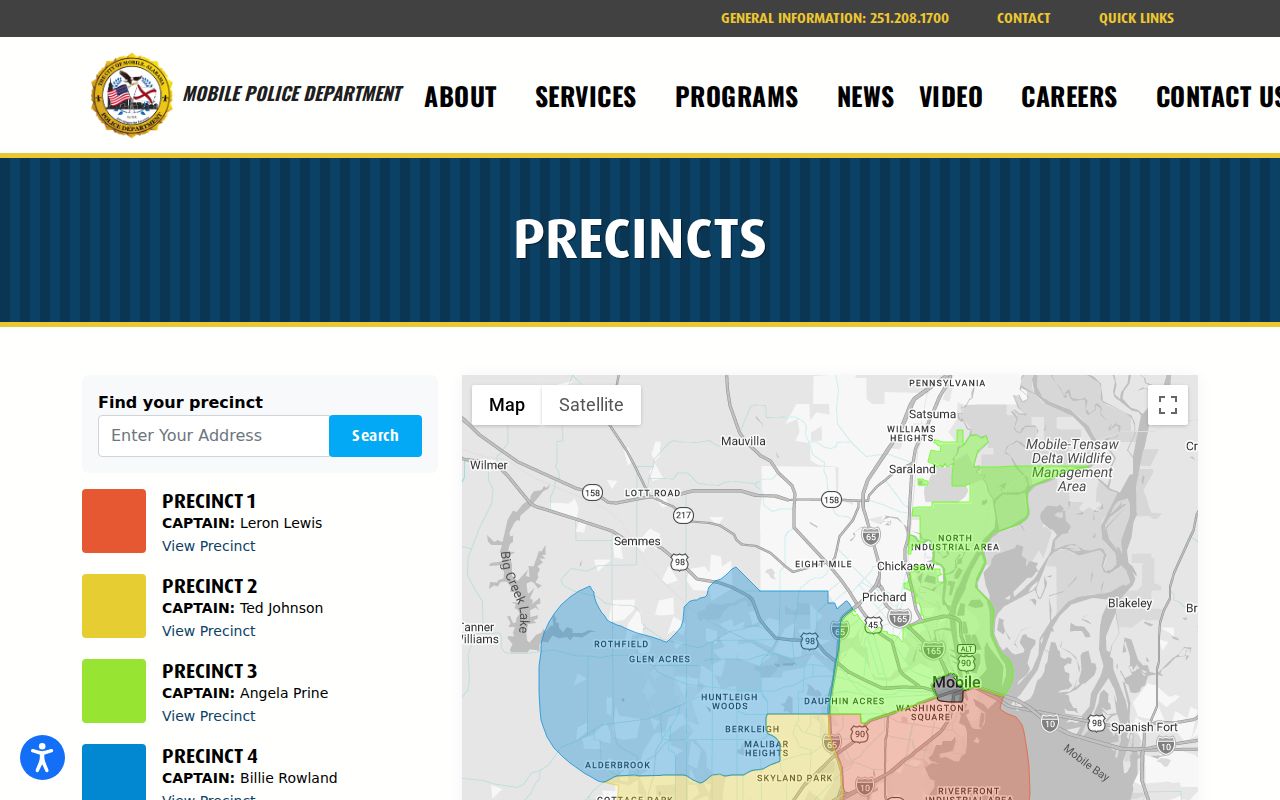
The precinct view can help identify where to ask about police service, while formal report release still runs through MPD Records.
Public Access Rules
Alabama residents may inspect and copy public records unless another law makes the material nonpublic. A city custodian can require a reasonably specific request, proof of permanent Alabama domicile, the agency's form, and advance reasonable fees. Police investigatory material, juvenile and youthful-offender files, victim details, and confidential identifiers can be withheld or redacted. The judicial branch follows court-record access and privacy rules rather than the administrative timetable that applies to ordinary agency requests.
Key Statutes:
Alabama Code §36-12-40 gives Alabama residents a right to inspect and copy public records unless another law restricts access.
Alabama Code §§36-12-43 through 36-12-45 define residence proof, request classes, fees, and the administrative response timetable.
Alabama Court-Record Rules 104, 201, 202, and 401 pair public court access with protected case categories and confidential identifiers.
A standard request uses fewer than eight staff hours and is reasonably specific. Agencies generally acknowledge it within 10 days, then provide a substantive response or status within 15 business days after acknowledgment, subject to written extensions. A time-intensive request follows a longer notice, fee, and response track. These agency rules do not force an office to create a record that does not exist.