
How to Check Criminal History in Mobile County
Begin by naming the record, not by typing a name into the first search box found. A pending felony or misdemeanor belongs in Mobile Circuit or District Court. A recent arrest belongs in the Mobile County Sheriff's Office booking channels. An incident report remains with the agency that wrote it. A city ordinance case stays with its municipal court. For your own fingerprint-linked Alabama history, use the ALEA personal-review process. These sources overlap, but none replaces the others.
Gather a full legal name, prior names, date of birth, and any known case, citation, warrant, or police-report number. A case number is more precise than a name. When the question spans more than one event, keep a list of agencies and dates so that an old paper file, a recent booking, and a state entry are not mistaken for the same record.
Just One Look requires an account and charges $9.99 for a name or case-number search. A name search includes one case detail, and each added detail costs another $9.99. A no-match name search still uses the fee. Clerk requests avoid guessing at gated search fields, but they take at least two weeks. Circuit Criminal charges $10 for a computer search, $20 for a paper search covering 1984 forward, and $25 for microfilm at 1983 or earlier. Those fees apply even when staff finds no record.
- Check Circuit or District cases through Just One Look, or ask the clerk for a search.
- For recent custody, review the official 24-Hour Booking and Who's in Jail channels.
- Request a sheriff or police report from the agency that created it.
- Compare the filed charge and final result with the court file.
- Use ALEA Form 46 when you need to review your own statewide fingerprint-linked history.
Mobile County Records at Government Plaza
Mobile County's Government Plaza directory shows why an in-person search can involve several counters. Circuit Court, District Court, Municipal Court, the District Attorney, and the law library are in the North Tower at 205 Government Street. County administrative records occupy the South Tower. The complex opened in 1995, but older records may still shift from computer indexes to paper or microfilm.
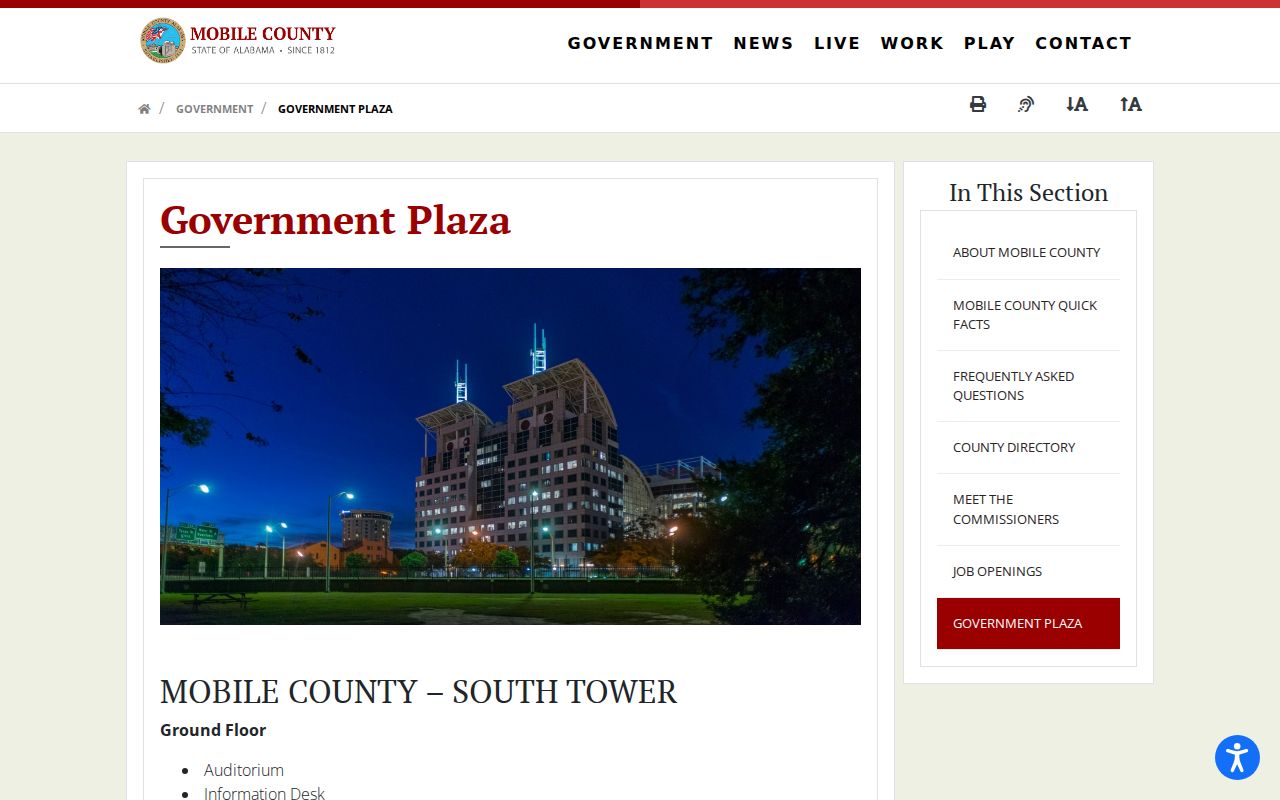
The image identifies the central court campus, not a single all-purpose records office. Visitors pass Court Police screening. Phones have generally been prohibited since June 10, 2024, except for jurors carrying a summons. Weapons have no storage option, and public areas bar open food and drink. Circuit Criminal is in Room C-927, while District Criminal is in Room 338. Calling the correct division first can prevent a trip to the wrong floor.
Mobile County's record history also explains the media split. Official county history records courthouse fires in 1823, 1840, and 1872. Surviving mid-nineteenth-century minute books are now archived at Government Plaza. A request for a modern case may begin in an electronic index, while an older name can send staff to paper or microfilm. The nearby Probate Court at 151 Government Street is useful as a landmark but is not the criminal clerk. MCSO Administration and Metro Jail are separate custodians at South Royal and St. Emanuel Streets.
Mobile Circuit Criminal
205 Government Street, Room C-927
Mobile, AL 36644
251-574-8430
Weekdays 8:00 a.m.-5:00 p.m.
Mobile District Criminal
205 Government Street, Room 338
Mobile, AL 36644
251-574-8511
Weekdays 8:00 a.m.-5:00 p.m.
MCSO Central Records
510 South Royal Street
Mobile, AL 36603
251-574-8660
Call to confirm counter hours
Official Alabama Background Checks
ALEA's Alabama Background Check System is a restricted subscription service for qualifying organizations. It is not an unrestricted public people search. A member of the public who wants to review their own Alabama Criminal History Record Information uses ALEA's personal review instructions and Form 46.
The packet needs a completed application, a valid government photo ID copy, classifiable fingerprints taken by an authorized law-enforcement agency with an FBI ORI, and a $25 cashier's check or money order. The signature must have two witnesses or notarization. ALEA estimates at least four to five weeks. Extra copies cost $5. A personal or business check is not accepted.
No official Mobile County page confirmed a current FD-258 fingerprint service or fee. Call MCSO or MPD before visiting and ask whether the location presently rolls applicant cards using its ORI. Alabama does not designate a universal IdentoGO or Fieldprint route for this personal review. The federal alternative is the subject-only FBI Identity History Summary, which costs $18. It answers a federal question and does not replace the Mobile County court, jail, or ALEA source needed for local detail.
| Form 46 item | What to prepare |
|---|---|
| Identity | Full name, aliases, birth date, address, and listed ID copy |
| Fingerprints | FD-258 card or approved AFIS printout from an authorized agency |
| Signature | Two witnesses or a notarized signature |
| Payment | $25 cashier's check or money order; $5 per extra copy |
Mobile County Form 46 Record Review
ALEA explains the difference between its restricted system and personal review. That distinction matters in Mobile County because a court name search is case-centered, while ALEA's file is identity-centered. Fingerprints link an arrest cycle to a state identification record. Court and prosecutor reporting should then supply the disposition.
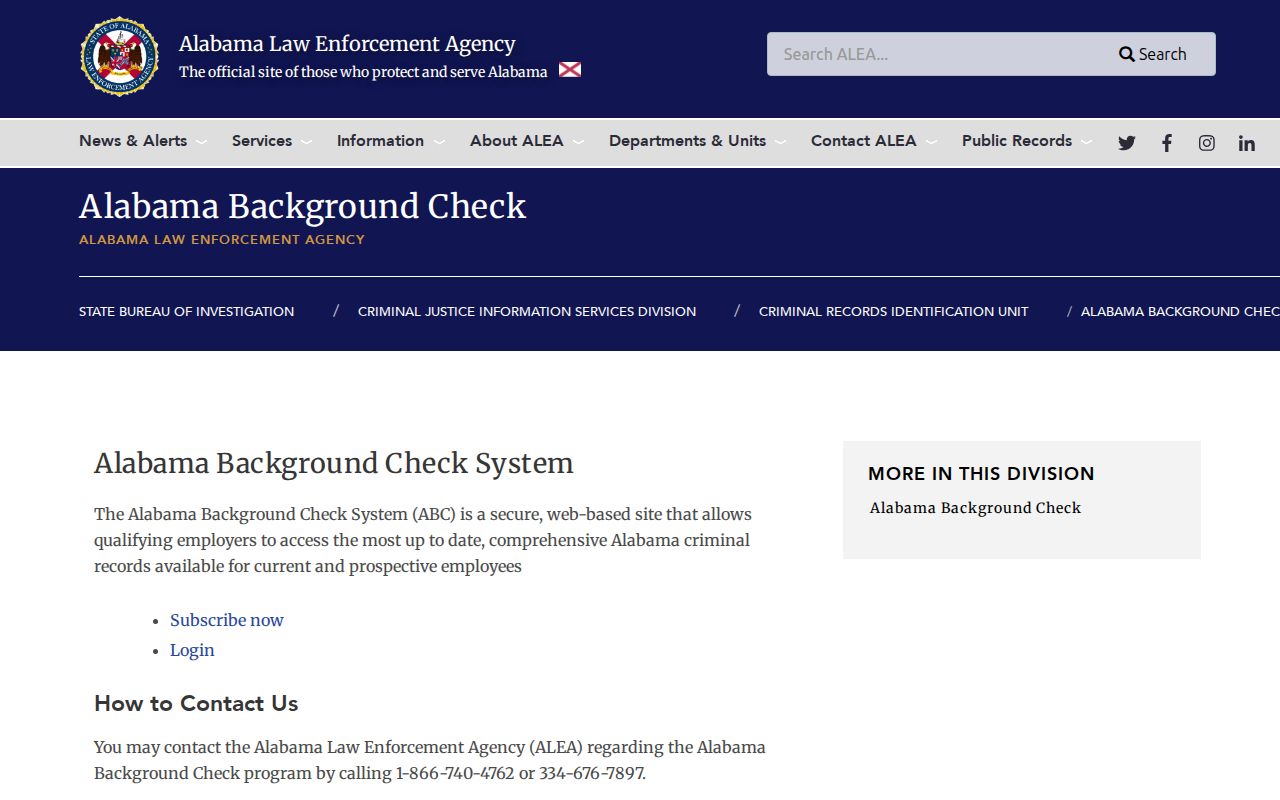
The official page is the starting point for Form 46, not a public name-search portal. A challenge can identify up to five disputed entries and should include the original CHRI, the believed-correct information, and proof from the source agency or court. ALEA asks that a challenge be returned within one year of the original request. Missing fingerprint links or delayed court reporting are reasons to compare the state entry with the underlying Mobile County file.
ALEA also maintains an expungement overview for records already ordered removed from normal public access.
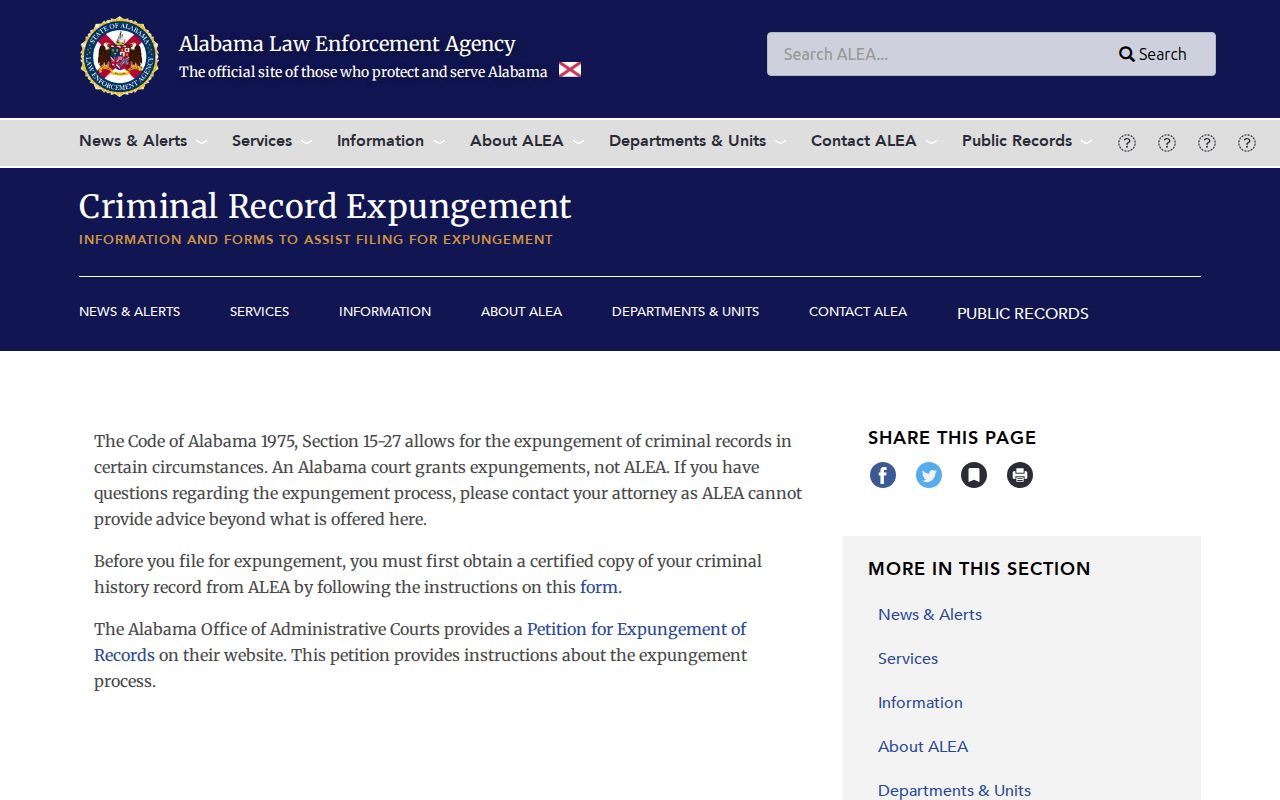
This source helps separate correction from expungement. A correction fixes inaccurate reported data. Expungement requires a court order under Alabama law.
The challenge portion of Form 46 asks for the date of the original CHRI and details for each disputed arrest entry, including arrest date, agency, charge or disposition, the reason it appears wrong, and the information believed correct. Official proof should come from the source court or agency. That process is especially important when a Mobile County docket shows a no bill, dismissal, or amended charge that did not connect to the correct fingerprint-supported arrest cycle.
Types of Criminal Records
Mobile County criminal history is a chain of records, not one file in one building. The arresting agency writes the incident and arrest report. Metro Jail creates custody and booking data. A clerk opens the case file when charges are filed. ALEA receives fingerprint-supported arrest information and later disposition reports. ADOC and ABPP cover different parts of custody and supervision.
Choose the source by the fact being checked. Booking proves a custody event, not guilt. The clerk is the stronger source for filed charges and final disposition. ALEA is the statewide source for a subject reviewing their own fingerprint-linked history, but it does not replace the narrative report or court docket.
Warrants are split again. A judge or magistrate issues the process, the clerk maintains court entries, and MCSO executes and tracks warrants in its system. Municipal bench warrants can remain in the issuing city's channel. Police reports follow the department that wrote them, so an MPD incident is not automatically available from MCSO. The public Alabama Sex Offender Registry is another separate product. Local officers register and verify covered people, then ALEA publishes the permitted fields from those submissions.
- Arrest and booking records: agency reports and Metro Jail entries show the start of the process.
- Criminal court files: Circuit, District, and Municipal clerks record filings, pleas, rulings, and outcomes.
- State CHRI: ALEA organizes reported Alabama events around identity and fingerprints.
- Warrants: the issuing court and Sheriff's Warrants Unit are the main confirmation points.
- Custody and supervision: Metro Jail, ADOC, and ABPP each cover a different status.
Mobile County Sheriff Records Requests
When an MCSO record does not appear in a public wrapper, Civil Division and Central Records is the fallback. The office is at 510 South Royal Street, Mobile, AL 36603. The direct number is 251-574-8660, and signed forms can go to recordsrequest@mobileso.com. The form requires Alabama residency and warns that vague requests can take far more staff time.
A useful description includes the subject, a date range, involved people, case number, location, and why MCSO should hold the record. Retrieval starts at $5. The first 25 pages cost $1 each, later pages cost $0.50, and digital records supplied on DVD cost $10. Payment may be by business check, money order, or cash in person. Never mail cash.
| MCSO item | Fee or method |
|---|---|
| Retrieval | $5 |
| First 25 pages | $1 per page |
| Pages after 25 | $0.50 per page |
| Digital records on DVD | $10 |
The official Mobile County Sheriff homepage provides the agency context for these channels.

The Sheriff's Office creates and holds its own incident and arrest material. City police reports must be requested from the city agency instead.
What a Mobile County Criminal Record Shows
The fields change with the source. ALEA CHRI can include identity data and fingerprint-linked arrest cycles. A Mobile County court file emphasizes the case number, filed charge, chronological docket, result, and sentence. The jail roster is much narrower. It showed only name, date, charge descriptions, and bonds during research. Read each field in the context of the system that produced it.
| Name & Identifiers | Names, aliases, birth date, SID, FBI number, or tracking number, depending on access level |
|---|---|
| Arrest / Booking Data | Arresting agency, arrest date, fingerprint event, intake date, booking charge, and bond where reported |
| Charges & Statutes | Arrest allegations, later filed charges, and cited Alabama provisions |
| Disposition | Conviction, dismissal, acquittal, nolle prosequi, no bill, or another recorded outcome |
| Sentence | Custody, probation, fine, restitution, or other terms entered by the court |
| Custody / Supervision Status | Current jail or prison custody and reported probation or parole status |
Inside Mobile County's Jail Roster
The Who's in Jail wrapper displays a long alphabetical list rather than a conventional search form. Research found four public columns: name, date, charges, and bonds. It did not confirm a public booking number, birth date, physical description, housing location, court date, release date, or charge class. Do not assume a field is present because another county's roster shows it.
Use the 24-Hour Booking wrapper for recent intake. If an embedded service fails, call 251-574-6412. The free Mobile County Sheriff's Office app also advertises Who's in Jail and warrant functions. A missing name may mean release, transfer, delayed display, different spelling, or a city record that has not reached the county system.
- Booking charge
- The allegation recorded at intake; it can differ from the charge later filed.
- Bond
- Security set for release while requiring a future court appearance.
- Disposition
- The court's recorded outcome, which the jail roster does not establish.
- Active warrant
- Outstanding court process, not a finding of guilt.
ADOC's Inmate Search serves a different custody layer.
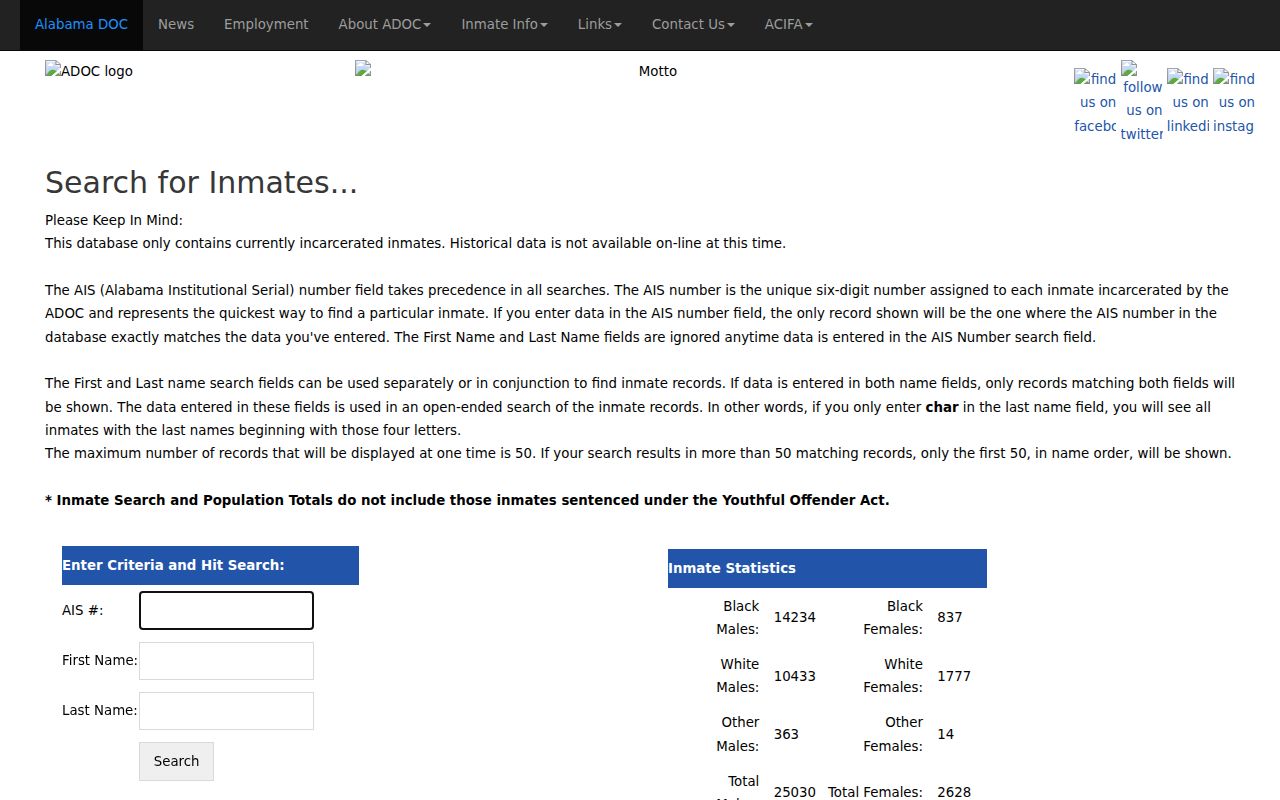
ADOC accepts an exact six-digit AIS number or a first and last name, with prefix searching on names. An AIS number overrides name fields. The database updates daily and omits Youthful Offender Act sentences. Metro Jail's custody channels serve another population. Its official average daily population is near 1,500, with a separate 325-bed minimum-security barracks. Those operating figures explain the value of checking the roster, recent-booking wrapper, automated phone line, and records office instead of treating one failed web response as final.
Public Access Laws
Alabama public access depends on the record and its custodian. The Open Records Law lets Alabama residents inspect or copy public records unless another law protects them. Court records follow judicial access and privacy rules rather than the administrative timetable. Juvenile, youthful-offender, sealed, expunged, victim, investigatory, and confidential identifier material can be withheld or redacted.
Key Statutes:
Ala. Code §36-12-40 - Alabama residents may inspect public records unless another law closes them.
Ala. Code §§36-12-43 to -45 - The law defines residency, fees, and administrative request timing.
Ala. Code §41-9-601 - False-pretense access or unauthorized sharing of offender information can be a felony.
Ala. Code §41-9-643 - Individuals may review and challenge their own ALEA criminal history.
Mobile County Warrant Search Fallbacks
The official MCSO Warrant Search wrapper is the first online county route, but its embedded host failed during research. The Sheriff's app offers another official path. If either tool fails, call the Warrants Unit at 251-574-8657. In-person and open-records routes go through MCSO at 510 South Royal Street.
Bench and failure-to-appear warrants can remain with the issuing Circuit, District, or Municipal Court. Search warrants, sealed process, and juvenile matters will not become public merely because a person checks a public interface. A possible match should be confirmed with the issuing court or Warrants Unit before anyone relies on it. Portal delay can leave newly issued or recently cleared process out of sync.
The official county directory helps route calls among courts and county offices.
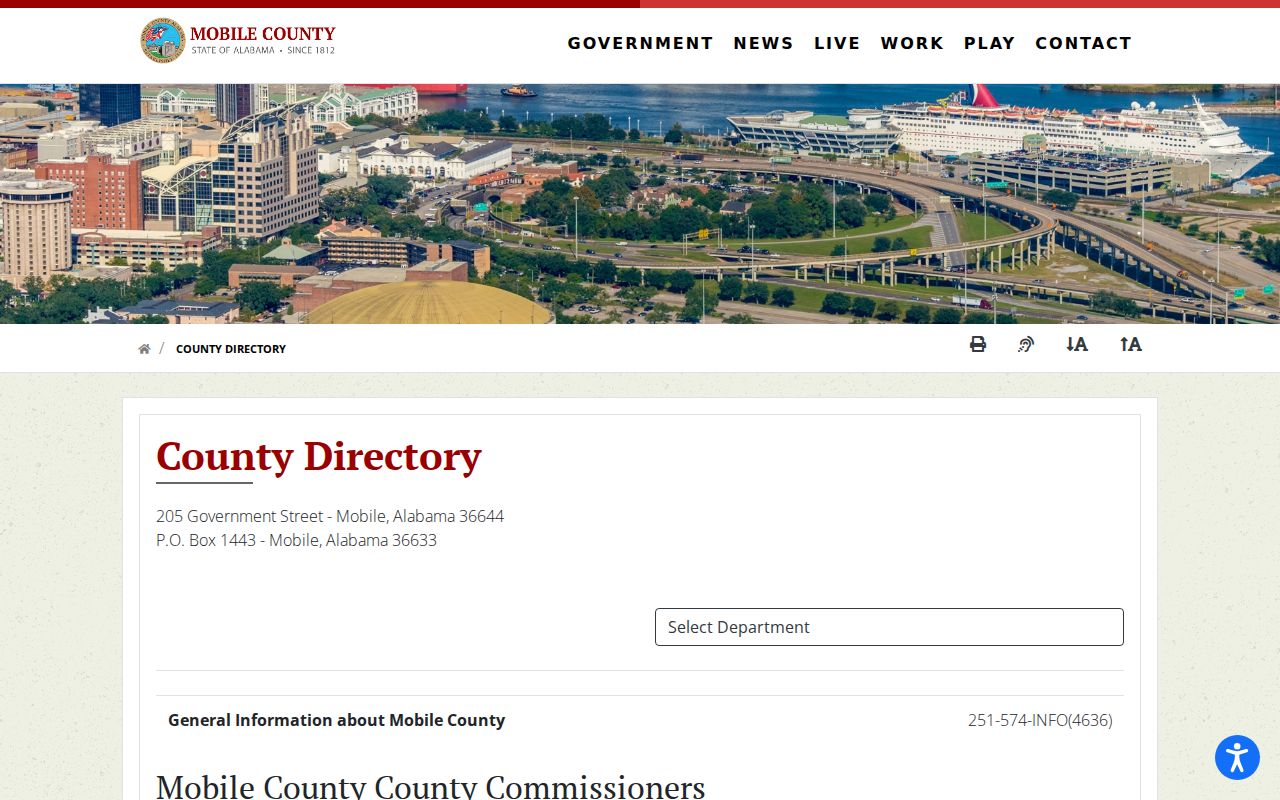
The directory is a routing source. It is not a warrant database and does not replace direct confirmation.
Sealed, Expunged & Restricted
Alabama law limits routine access to juvenile and youthful-offender records, adult probation reports, parole files, pretrial-diversion records, full Social Security numbers, and other protected identifiers. Expunged records leave ordinary public access, but Chapter 27 preserves access for specified criminal-justice, prosecutorial, regulatory, and related purposes. A blank public result is not proof that no record ever existed.
Form CR-65 is filed in the Circuit Court of the county where the charge was filed. A Mobile County charge therefore goes to Mobile County Circuit Court even if it began in Municipal or District Court. The form states a $500 filing fee unless indigency is found. Each petition must identify and serve the arresting, booking, detention, court, ALEA, and other custodians. An office omitted from service may keep its copy.
Mobile County Custody and Supervision Records
Three systems answer three different questions. Metro Jail shows local pretrial or short-term custody. ADOC Inmate Search shows current Alabama state-prison custody and omits Youthful Offender Act sentences. The Alabama Bureau of Pardons and Paroles has no confirmed public statewide name search for live probation or parole supervision.
The Mobile ABPP Field Office is at 1514 South Broad Street and can explain its proper verification procedure. Public court records may show a sentence, revocation motion, or revocation order even when the detailed supervision file is privileged. The Mobile Day Reporting Center provides structured programs, but it is not a public lookup counter.
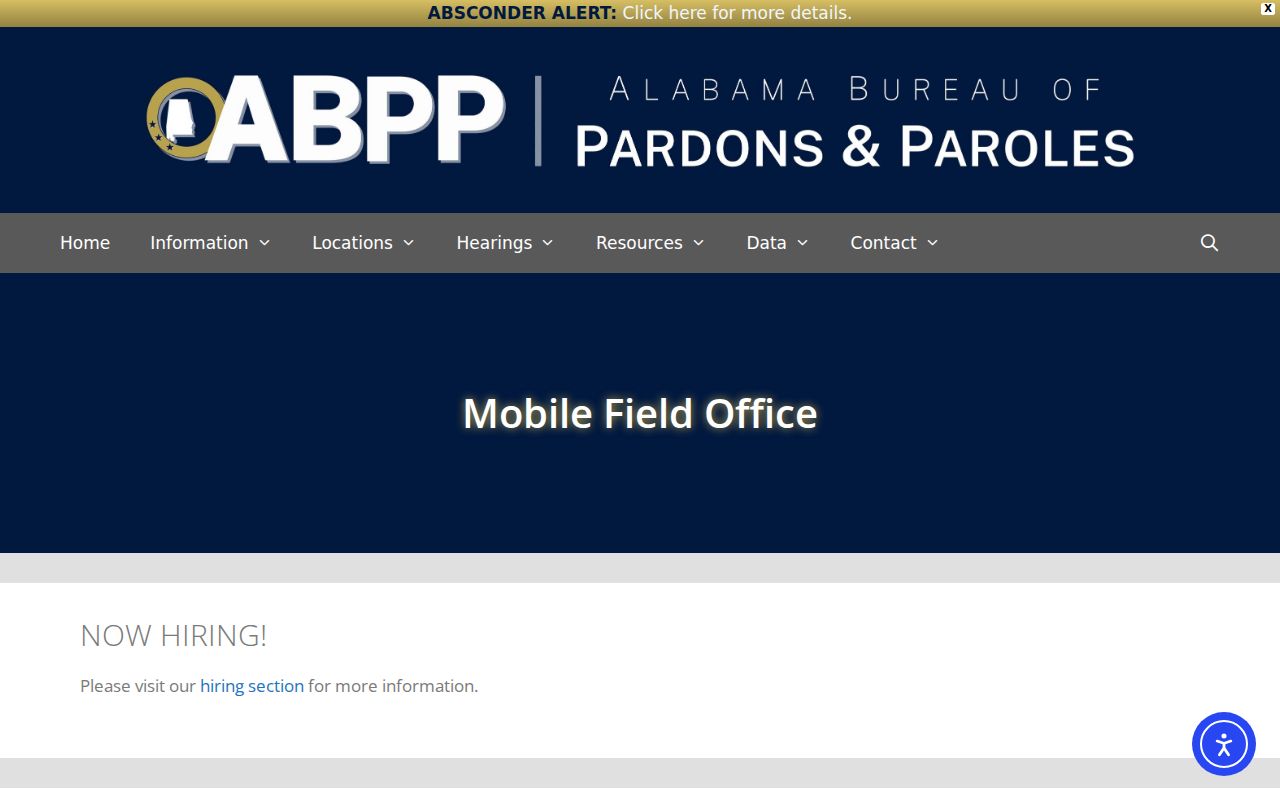
The official field-office image represents the supervision layer. It should not be read as proof that any named person is under supervision.
- Metro Jail
- Recent booking and current local custody, not the final case outcome.
- ADOC
- Current state-prison custody, not county jail or released history.
- ABPP
- Felony probation and parole supervision, with no confirmed public name lookup.
Criminal Records by City in Mobile County
City police departments keep the reports they create, while municipal courts keep their ordinance, traffic, and city-level misdemeanor cases. Mobile offers a broad municipal record search. Prichard publishes three police request forms and a citation portal. Saraland supplies direct police and court contacts, a court-record form, and citation search. County booking and felony case channels remain separate.
Mobile Criminal History
200,824 · MPD records and a multi-field Municipal Court search
Prichard Criminal History
18,825 · Police request forms and citation lookup
Saraland Criminal History
16,652 · Police, court, warrant, and citation channels
Mobile County Accountability Court Records
Mobile County's criminal docket includes named alternatives to a standard case path. Drug Court, Mental Health Court, and Veterans Treatment Court operate through local accountability teams. Community Corrections is a separate diversion and reentry structure under ADOC oversight. These programs do not erase a public case by themselves, but participation, disposition, and later eligibility can change what the docket shows.
The Circuit Court lists Drug Court at 251-574-5650, pretrial at 251-574-5665, jail-diversion probation at 251-574-3296, and Community Corrections at 251-574-5685. The court file remains the place to confirm a particular case outcome. A nolle prosequi, dismissal, diversion completion, or probation entry should be read by its recorded status rather than guessed from program participation.
Record flow: Arresting agency › Metro Jail › prosecutor › Circuit, District, or Municipal Court › ALEA disposition reporting.